
Pensions & retirement
State pension 2025 – What you'll get and how to claim
7 mins read
by
Ann Causer
Last updated 5 October, 2026
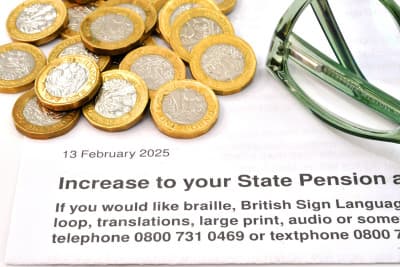
For many, the UK state pension is a very important, if not vital, part of their retirement income.
Every april, the state pension changes. It's important to be aware of these changes and assess their impact on your retirement income and planning. We will help you be aware, and we will outline the main steps to claim it.
Table of contents
Summary
- The UK state pension starts at age 66 (rising to 67 from 2026).
- You need 10 years of NI contributions to qualify, 35 for the full amount.
- Payment rates change every april, stay updated for planning.
What is the UK state pension?
The UK state pension is a regular payment from the government, and the payments help to support people during their retirement.
When you reach the state pension age, which is currently age 66 (rising to 67 from 2026), you can claim your state pension. It is not possible to claim early. However, you can choose to defer and receive an increased pension later.
The amount of state pension you are entitled to is dependent on several factors, the main thing being the amount of qualifying national insurance (NI) contributions you've built up.
You can claim the new state pension, providing you have 10 qualifying years on your national insurance record. However, you will need at least 35 qualifying years to get the full state pension of £230.25 a week.
If you have less than 35 qualifying years, you'll get a reduced amount and only a proportion of the new state pension.
About annual state pension increases
Every April, the state pension increases under the government guarantee called the 'triple lock'. The guarantee means an annual increase of at least 2.5%, but could be more than 2.5% if inflation or average earnings growth are higher.
This year, for example, the state pension increased by 4.1%, which aligns with average earnings growth. The increase relates to the highest of the three triple lock measures and this year; it is average earnings growth.
The actual figures used to calculate the state pension 2025 increases are average earnings growth from the previous may to july or the CPI measure of inflation from the previous September.
If earnings growth or inflation is lower, the guaranteed 2.5% increase applies.
How much is the state pension 2025-2026?
Your state pension income depends on whether you are eligible for the new state pension or the basic state pension.
New state pension
The full new state pension 2025 is £230.25 per week, totalling £11,973 annually. It applies to men born on or after 6th April 1951 or women born on or after 6th April 1953.
The full amount depends on having 35 years of qualifying NI contributions.
Basic state pension
The full basic state pension 2025 is £176.45 per week, or £9,175.40 annually. It applies to men born before 6th April 1951 or women born before 6th April 1953.
The full amount depends on you having at least 30 years of qualifying NI contributions.
Related article
Learn more: How to sort out gaps in your state pension contributions
Get a state pension forecast to check what your state pension will be
The government has a new digital online service for checking your state pension forecast and national insurance records.
To find out what you will get from your state pension 2025 when you retire. Simply log into the UK government gateway.
You will need a 12-digit government gateway ID and must register to get one if you do not have this ID. You need an email address, which you will need to verify.
Also, as part of the verification process, you must provide ID such as a valid UK passport and/or a current driving license.
Once registered and logged in, you can check your state pension forecast. You can see many statistics about your state pension. Such as how much you'll get, when you'll get it, your qualifying years, and ways to increase it. It is all very thorough and easy to use!
If you cannot access the HMRC's online service. Contact the DWP Pensions Service on 0800 731 7898 or the Future Pension Centre on 0800 731 0175.
They will be able to help and supply you with the information you require.
Ways to claim your state pension
Your state pension payments don't automatically start when you reach state pension age. And you need to actively submit a claim.
You will receive a letter from the Department of Work and Pensions (DWP) explaining how to claim. This letter should arrive around four months before you reach state pension age.
Claiming by post
You should receive a form with your DWP letter. Just complete the form and send it back. If you do not receive the form, you will have to call the Pension Service on 0800 731 7898 and request it.
Claiming by telephone
You can also make your claim by calling the Pension Service and providing them with the relevant information.
Claiming online
You can apply online via the government website www.gov.uk/get-state-pension. Just follow the instructions and complete the required information.
Speak to a financial advisor
We'll match you with a qualified advisor who understands what happens to your pensions when you divorce. You can be up and running in minutes.
Find a financial advisorHow does the state pension impact my retirement planning?
Although the state pension increases annually, it is certainly not sufficient for a comfortable retirement.
With the introduction of auto-enrolment in 2012, employees have had the opportunity to join workplace pensions with their employers.
If you can afford to, try to contribute more to these pensions. It will certainly boost your retirement savings. Remember, you'll earn tax relief from the government in addition to your contributions at the same time.
In addition, you can contribute to a personal pension, which will also help to build up extra retirement income. You'll also be eligible for, and benefit from government tax relief that adds even more to your pension funds.
The consensus is that, if you can and whilst you can, try to contribute as much as possible to other pensions so that you are not solely reliant on state pension 2025 income.
Join our newsletter
By signing up, you consent to receive our emails, news, and blogs. Your data will be stored securely with our Privacy policy and Terms & conditions.
Related articles
How to change the address for my pension?
How do voluntary national insurance contributions work?
Do married couples get separate state pensions
Explore the topic
Pensions & retirement
Need a pension advisor?
Ann Causer
Content Writer
Ann worked at RMT Group for over 10 years between 2013 and 2024, working in administration, sales, customer services and content writing for Regulated Advice. Ann is highly experienced in working with both financial advisors and clients alike. Ann played a major role in the development of RMT over the years.
Read next

Pensions & retirement
How to change the address for my pension?
Pensions & retirement
How do voluntary national insurance contributions work?
Pensions & retirement
Do married couples get separate state pensions

Pensions & retirement
How much is the new state pension and when can I get it?

Get professional advice